Should I learn the whole chapter at once?
No. One verse, then the joint to the next verse, while you keep reviewing the earlier lines.
Holdfast blog

A chapter feels different from a verse because you cannot hold the whole thing in working memory at once. People who succeed do not stare at all six, or all forty, verses and hope. They learn a piece, attach the next piece to it, and keep reviewing the earlier lines so the beginning does not fall out while the end is still new. The method is the same one used for a single verse. The difference is the order of the pieces.
This article uses Psalm 23 in the King James Version as the worked example. That translation is in the public domain, so the lines can be quoted here. In Holdfast, the wording you practice is the licensed translation in the app, which may not be the King James Version. Learn the chapter in the translation your church or you have actually chosen. Do not mix wordings. Two versions of the same verse will tangle.
Psalm 23 is six verses. It is concrete: a shepherd, grass, water, a valley, a table, a house. People often already know the first line, which is an advantage, not a reason to feel you are cheating. Familiarity is a cue you can lean on and then remove.
The first verse, in the King James Version, is: “The LORD is my shepherd; I shall not want.” If you can say that line, you have a hook for verse 2. If you cannot, do not open verse 2 yet. A chapter memorized with a hole in verse 1 becomes a chapter you have to restart.
Longer chapters, such as Romans 8 or 1 Corinthians 13, use the same pattern. They just take more weeks. Start with a chapter you are willing to still be working on next month. Quitting at verse 4 is the usual way chapters die.
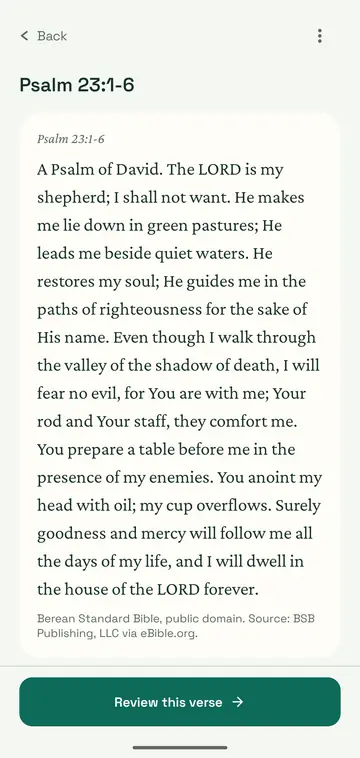
The screen shows Psalm 23 in the Berean Standard Bible. The quotations earlier in this essay are from the King James Version, which is named where it is quoted.
Treat each verse as its own small passage for a day or two. Read it in the paragraph so you know what it is doing. Practice with blanks or first letters. Say it from memory once, cleanly. Then stop for that verse.
The joint is the part people skip. Before you add the next verse, say the previous one and the first few words of the new one together. The seam is where memory breaks. “I shall not want. He maketh me to lie down” is a joint. Practice the joint on purpose, out loud, until the first words of the new verse arrive without a hunt.
Verse 4 is the line many people want and then scramble: “Yea, though I walk through the valley of the shadow of death, I will fear no evil: for thou art with me; thy rod and thy staff they comfort me.” It is longer than verse 1. Split it at the colon if you need to. Learn the valley clause, then the rod and staff clause, then the whole verse, then the joint from the end of verse 3. Do not rush the long verse just because the short ones felt easy.
Each day, say what you already know before you learn the new piece. At first that is one verse. By the end it is the chapter. This feels slow. It is the reason the beginning survives.
A simple order for Psalm 23:
Those day counts are a shape, not a promise. If verse 4 takes four days, let it. If you already know verses 1–3, start at the first verse you cannot say. Do not perform verses you know in order to avoid the one you don’t.
Once the chapter holds, the reviews get farther apart: the next day, a few days later, the next week, then when you notice it slipping. A chapter you never review becomes a chapter you used to know. Spaced review is how you remember it after the first intense week. The spaced repetition article explains the idea without turning it into a formula you have to calculate.
When you recite, follow the story. Shepherd, pasture, path, valley, table, house. If you lose a line, go back to the image before it rather than starting at verse 1 every time. Starting over teaches you the opening and starves the ending.
Recite to a person if you can: a friend, a child, a small group. A listener catches the word you smoothed over. If you are alone, record yourself once and listen. You will hear the clause you mumbled.
Keep the punctuation in your ear. A semicolon is a breath. Rushing through it is how two verses weld into a sentence the translation never wrote.
Do not learn verse 6 because you are bored of verse 2. Boredom in the middle is the work. Do not switch translations halfway. Do not add a second chapter the week you finish the first. Let the finished chapter ride a few reviews so it is actually yours.
Do not turn the recitation into a test for someone else, especially a child. A chapter said together, with the text still available when someone sticks, is practice. A chapter demanded with no help, in front of a room, is a performance. Those are different things. Families who want a shorter start can use the kids article and one verse of the psalm before the whole chapter.
You can keep each verse, or a few verses, as its own passage and let Today tell you which piece is due. That is often kinder than one giant passage you have to attempt all at once. When the pieces are steady, practice the whole chapter as a single recall. The garden is a picture of that progress. It is not a scoreboard.
When a line is almost known, the mouth skips the small words: unto, thou, thy, the second “and.” Those are the words that make a recitation sound like the translation instead of a paraphrase. Once a week, read the verse silently while you listen to yourself say it, or follow with a finger. Mark the word you dropped. Practice only that joint the next day. A chapter is won in those small repairs, not in another triumphant run of the verses you already love.
If you pray the psalm, pray the wording you memorized. Switching into your own paraphrase while you pray will train the paraphrase. There is room to pray in your own words after you have said the text. Do the text first, then the prayer. That order keeps the chapter from slowly becoming a different chapter.
The same loop is written as a shorter method in how to memorize Bible verses. A chapter is that loop, repeated, with the joints practiced on purpose. If you want the phone to hold the next piece, the apps are in private beta: TestFlight for iPhone, Google Play internal testing for Android, both linked from download.
No. One verse, then the joint to the next verse, while you keep reviewing the earlier lines.
The one you will actually practice. Do not mix wordings. The Psalm 23 lines in the essay are King James Version.
After this one has survived a few reviews with a gap.
Related: how to memorize, all posts, guides.